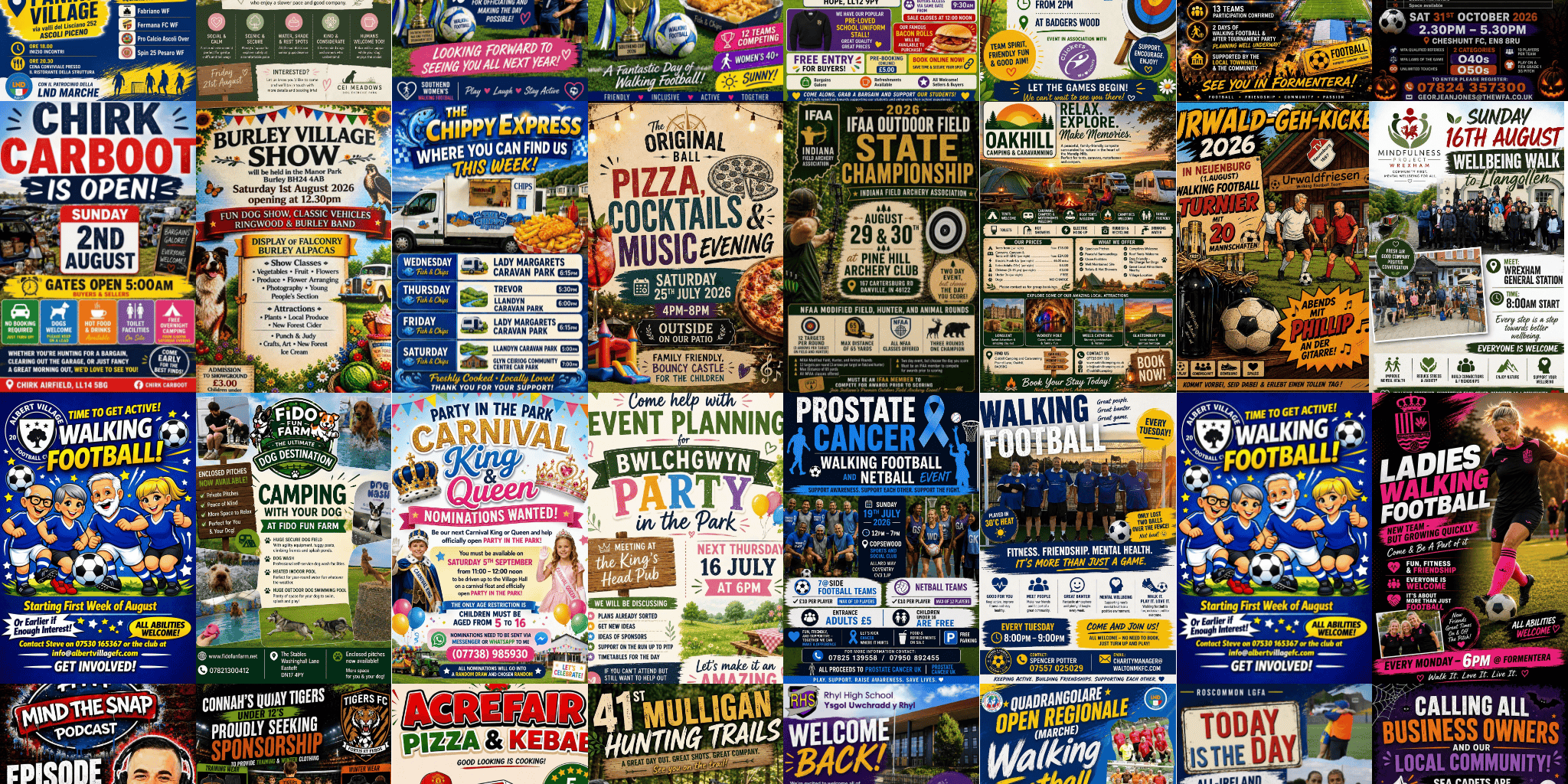
You have all seen them. Spend 5 minutes on Facebook or on most other social media sites, and you will come across a poster for a local event. It will look kind of professional, especially for the local event it is promoting. Much better than the last time someone publicised the event.
Then you scroll a bit further and up pops another. It sort of reminds you of the last one you just saw. Same kind of layout, lots of information, perhaps too much information, but all laid out methodically.
Maybe ten posts later, another one scrolls into view. This one is for a local dog grooming business, or a local sports team promoting their upcoming trials.
I recently spent a couple of hours in a hospital waiting room, using the hospital’s pretty good free Wi-Fi (shout-out to Betsi Cadwaladr Health Board), mindlessly scrolling social, mostly Facebook. The collage of images in this post all came from that two-hour session. There were dozens more!
AI, democratising design
All of them are created by AI, probably all by ChatGPT. “AI Slop”, you all shout, but is it? It’s not slop to the people who created them. They are delighted to be able to produce something that promotes their event or business and looks good.
AI has allowed anyone with something to promote to do so in a much more professional manner than 12 months ago. Before AI, most of these types of posters were nasty clipart jumbles. For the general public, this is a massive upgrade. AI has democratised design in that way.
Designers look at them and, for good reason, hate what they see. Firstly, they hate the generic, soulless design. But they also have a small bit of fear. In fact, it might be more than a small bit.
If you’re a designer working in a top agency for large brands, you’re not bothered. You see this local stuff as beneath you, unworthy of comment – a source of entertainment. “Look at these yokles, thinking they can design”. Pathetic.
Are designers missing the point?
When designers dismiss this work, I think they are missing the bigger picture. The people they are mocking are the consumers, and the more consumers see this design, the more it becomes the norm.
Look back through the history of communication through design, and you’ll see trends. Trends that became the norm. Look at event posters from the 19th century. They were all of a style that you don’t really see now. Why? Because it was a trend that everyone followed, and then it died out.
Ironically, I think they have something in common with today’s ChatGPT posters. Lots of information vying for your attention. Back then, these posters were created by what may have been called a commercial or poster artist.
The term ‘graphic designer’ was first used in the 20th century and is widely attributed to William Addison Dwiggins.
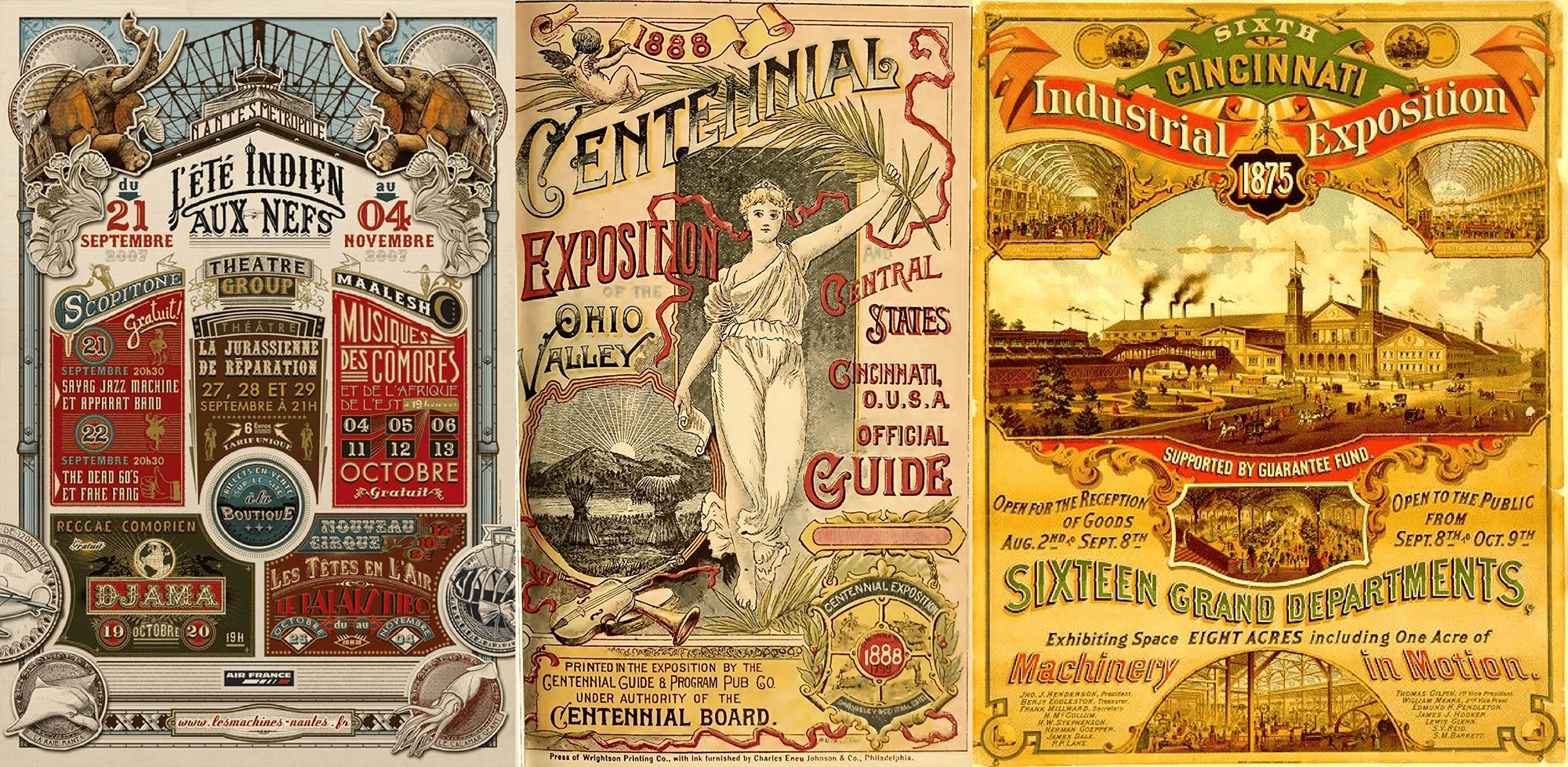
Trend after trend followed. All became the norm for a period, and then designers and the public moved on. What all of these trends had in common was that professionals created them, and you needed skill and vision to create work in line with current trends – even more skill to invent the new trend.
But without knowing it, and thanks to AI, your mate’s mother, a distant second cousin, some bloke down the pub, and your mum’s best friend, sister’s daughter, who jumped on ChatGPT to make a jumble sale poster, have created a new trend.
What happens when your client uses ChatGPT?
Unless you live under a rock or don’t have a computer or phone, you know AI exists. And if you’re at all curious, you will have had a play with it. That’s harmless, right? I mean, your client isn’t going to get ChatGPT to knock out their new company brochure, right? They are going to get you, a trusted, experienced, talented designer, to do it, right?
The answer is more complicated than it might seem. Most clients would not do that, not yet, at least. And again, if you work for a top agency with big clients, the chance of this is almost nil. But most designers are not in that position. Many designers are freelance or self-employed, and their clients are not global brands, but local businesses or SME’s. Whilst even clients of this size will not want to create the design themselves using AI, they are using AI to review the work.
I recently listened to a phone-in on LBC about AI. A designer was explaining to the host that they had created a brochure for a client and had sent them a design, presumably a PDF, to review. The client had fed their design into ChatGPT and asked it to make suggestions. The caller explained that ChatGPT had essentially redesigned it, and the client sent ChatGPT’s design to the designer for implementation.
As a side note, this has happened to me several times. Luckily, not in business, but personal stuff. In fact, it happened today, while I was writing this! Someone sent me a design they had created using ChatGPT for an event I’m involved in. My response was, “You know I do this shit for a living!!!!”
As it is apparent that AI, and in particular ChatGPT, has a ‘style’ (as seen above), the more this happens, the more the ChatGPT design becomes what people expect to see, creating what the public sees as the current design trend.
ChatGPT, the new Bauhaus?
Ok that is a bit of a stretch. But you must see the parallel. Bauhaus was probably the most influential design movement of the 20th century, and its principles are still used by designers today. The simple, clean lines and bold sans-serif fonts were hallmarks we still see today. Eric Gill created Gill Sans in 1926, right in the middle of the Bauhaus period. Swiss Design, which Bauhaus spawned, gave us the font Neue Haas Grotesk, designed by Max Miedinger and Eduard Hoffmann, better known after a name change as Helvetica.
Whilst I don’t think the wave of AI designs will influence designers in 100 years, as Bauhaus and Swiss Design have, its influence is growing by the week, not influencing designers directly, but influencing the public. A simple example of how things become the norm over time is the fonts we all use in emails, apps and in software such as Word. Times New Roman was the default font in Word and email for a long time. Now it is Aptos or Calibri. We just take it for granted and crack on. Most people probably don’t even notice the font they use in this type of software, but these fonts are the new trend.
If the public sees more and more of these AI-created designs, to the point that they expect it, what happens when they see a different design? There is a chance it doesn’t hit home, doesn’t resonate with them. That is a point at which actual designers have to consider making their work look AI-generated to get traction. That will be a dark day for design.
Why does this matter and why should you care?
In one way, it shouldn’t matter. Design has always been and will always be subjective. It passes in front of billions of people every day, and most people don’t even consider that someone or an AI has created it. More importantly, they don’t care. They are influenced by it, even if they don’t realise or admit it. Given two products priced the same and essentially the same, packaging design will influence the shopper’s choice. A great example of this is wine labels. Faced with shelf after shelf of wine bottles in a supermarket, unless you are an expert, choice will come down to price, the grape variety and then the label.
Should you care? I’d say yes. Today, it’s jumble sale posters and local fetes, but this really is the tip of the iceberg. If AI design created by non-designers becomes more widespread, its influence grows more profound. When that happens, it moves from social media posters to social media ads, then to offline ads and posters, magazines, book covers and product packaging. In that future, how do you stand out if AI is creating it and reviewing its own work?
More importantly, who is the next Eric Gill, the next Max Miedinger? Why would you bother to be an innovative designer if the public doesn’t want it, and even if they do, AI is going to take your brilliance and churn it out for anybody who asks it to make a poster?
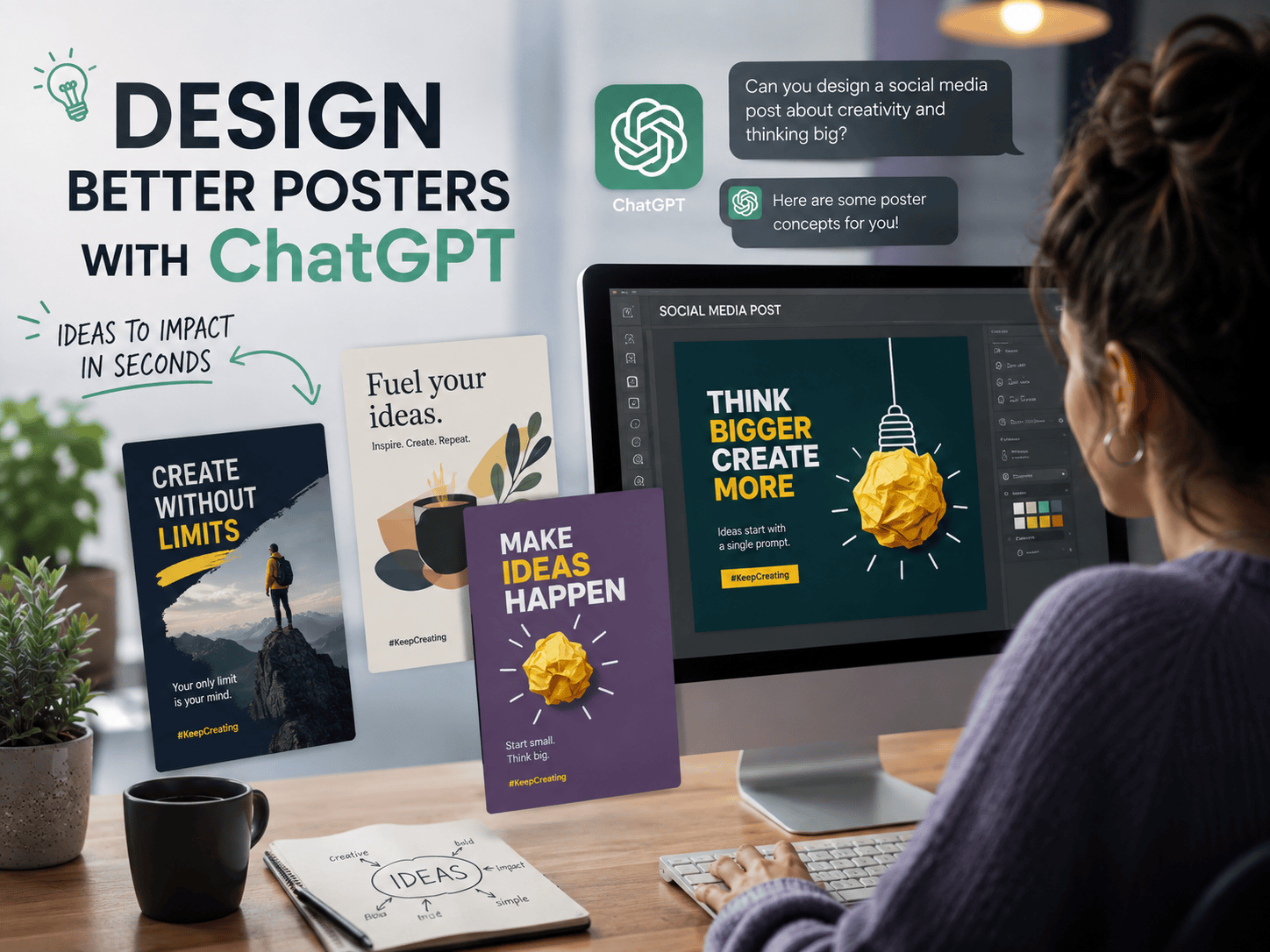
P.S. I asked ChatGPT to make me a header image for this post. This is what I asked
“Create an image for the header of a blog post about people using ChatGPT to design their posters for social media. The image should be 1024px wide by 768px deep”
This is what it gave me!